Prison Inmate Work Programs
- Leading Offenders To Work: Bridging The Gaps Between Prison, Community Supervision, And Employment(WSU, CI)
- State Prison Programs For Inmates
North Carolina Department of Correction -- Inmates Work
The Prison Entrepreneurship Program (PEP) focuses on changing inmate behavior and aims to lessen the likelihood people like Chavez will end up back behind bars, the Associated Press reported. It teaches skills valuable in an entrepreneurial setting - like writing a business plan and finding financing to launch - and is making a measurable. At the Prison Entrepreneurship Program, we are servant leaders on a mission to transform inmates and executives by unlocking God-given potential through entrepreneurial passion, education and mentoring. PEP is dedicated to delivering the nation’s best outcomes in the prison re-entry field.
North Carolina Prison Inmates at Work
- In the traditional industry prison work programs, inmates manufacture or service goods such as name plates, mattresses, desks, shelving, seating, bookcases and more. These items are sold to state, county and municipal offices school districts, and nonprofit organizations.
- As of June 2019, Florida had 145 prison facilities, including 50 major institutions (7 of which were privatized with the contracts overseen by the Department of Management Services) 17 annexes, 34 work camps, 30 community release centers (includes 18 contracted), 3 road prisons/forestry camp, 1 basic training camp, and 3 re-entry centers.
- At the Wisconsin Department of Corrections, we are focused on public safety through the custody and community supervision of offenders. We offer education, programming, and treatment to offenders to enable them to be successful upon their return to t he community.
| Today's N.C. prison inmates work on the farm, on road crews and in prison construction. More than 2,000 minimum and medium custody inmates from more than 60 prisons work on the state's roads, clearing right-of-way, picking up litter and patching potholes. | |
| Medium custody inmates work under the supervision of armed correctional officers. Minimum custody inmates work under the direction of Department of Transportation employees. | |
| Inmates at the state prison farms at Caledonia and Odom Correctional Institutions raise crops and cattle that supply food to prison kitchens around the state. Inmates learn operation of farm machinery and innovative farming methods. Inmates also work in farming operations at the Dan River Prison Work Farm at Yanceyville and Tyrrell Prison Work Farm in Tyrell County. |

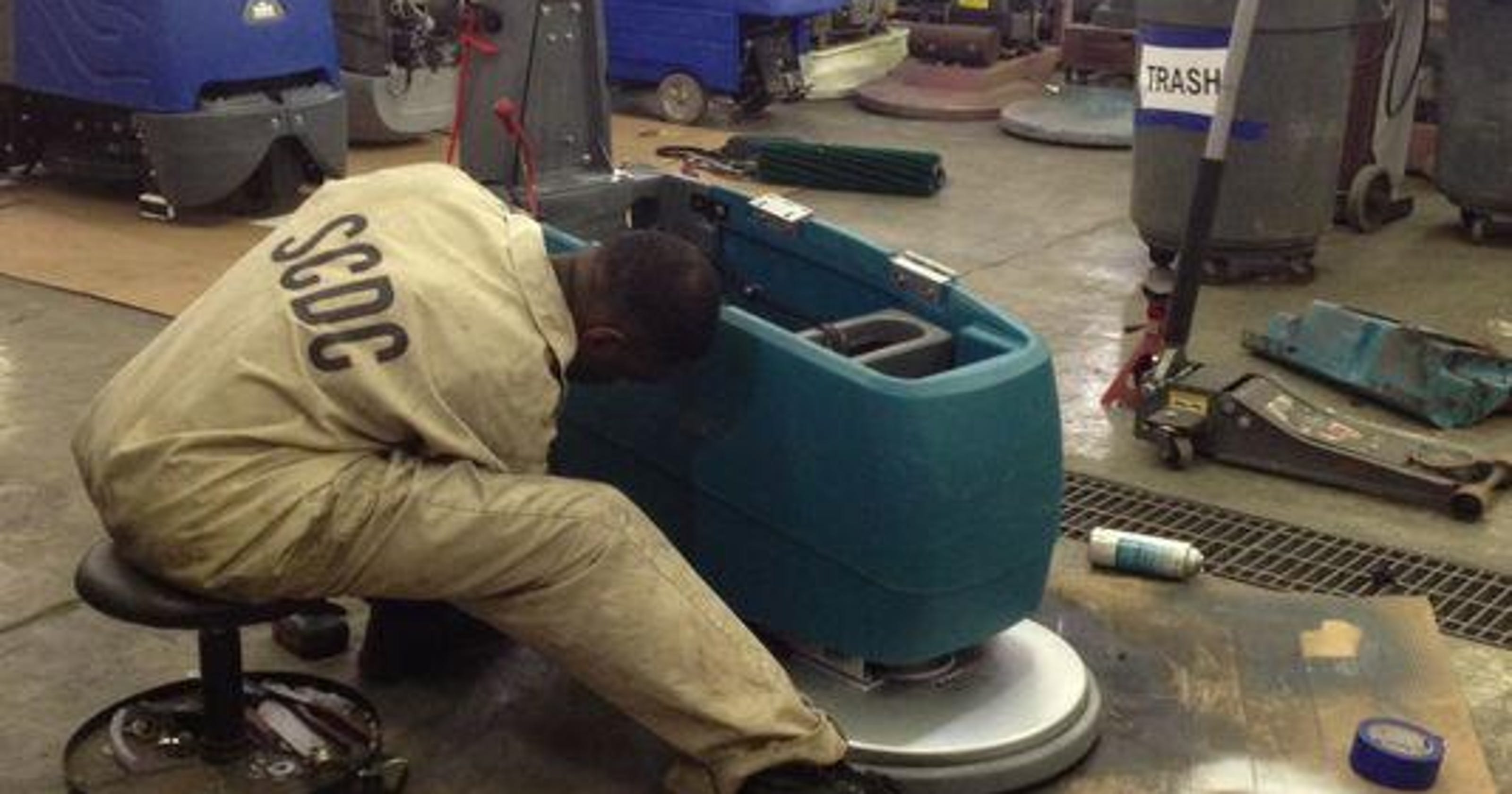
| Inmates under the supervision of correction engineers continue to work on construction projects. They have completed two prison work farms and a female boot camp housing unit in Richmond County. They have completed on a prison industry sewing plant at Columbus Correctional institution and a green house for the Dan River Prison Work Farm. Inmate crews are also building wall panels and constructing several new houses in Tarboro and Kinston for victims of Hurricane Floyd. |
| More than 6,000 inmates work inside the prisons preparing meals in the kitchen, keeping buildings and grounds clean and providing labor required in prison operations. |
| Correction Enterprises operates 37 prison industries that employ 2,000 inmates. Enterprise employees train unskilled inmates to make t-shrits, license tags, highway signs, street signs and highway paint. They learn to make office furniture, janitorial supplies, beds and lockers. |
| In the Governor's Community Work Program, correctional officers supervise minimum custody inmates in short-term, manual labor jobs for local government. The program was piloted in 1994 at Greene Correctional Center. More than 1,300 inmates from 43 state prisons now work in the program. Prisons can also contract with local governments to provide inmates to work on longer term projects. Some counties use inmates to work in recycling projects, while others perform clerical duties. |
Work release provides employment for 1,100 nearing release from prison. They work for businesses in the community developing skills and contacts that will help in getting a job after release. Money earned by the inmates helps defray the costs of their imprisonment, pays restitution to victims and helps support their family.
Inmates being processed into prison, being segregated for violating rules or receiving medical care are assigned jobs as soon as they enter the regular inmate population. Many inmates lack the education and skills needed to make a living after they leave prison. More than 2,800 inmates are in education and vocation classes that will prepare them for future jobs in prison and after their release.
Inmates sent to N.C. prisons should expect to work. General Statute 148-26 declares that:
all able-bodied prison inmates shall be required to perform diligently all work assignments provided for them. The failure of any inmate to perform such a work assignment may result in disciplinary action. Work assignments and employment shall be for the public benefit to reduce the cost of maintaining the inmate population while enabling inmates to acquire or retain skills and work habits needed to secure honest employment after their release.
Upon arrival at one of Indiana's correctional facilities, an offender meets with Case Management staff to begin building their Case Plan. The Case Plan is developed from the results of the Indiana Risk Assessment System (IRAS), which is based on the following criminogenic risk domains:
- Criminal History
- School and Employment
- Family and Social Support
- Substance Abuse and Mental Health
- Criminal Lifestyle
By focusing on these risk domains, Case Management staff can identify solution-based programming that helps break down barriers to successful Re-Entry.
The Indiana Department of Correction has categorized all offered programming into one of the following categories.
- Activity: Facility specific activities that are approved by the facility head, which do not meet the criteria of a Program or Course.
- Course: Group or self-study approved by the Commissioner or their designee with standardized curriculum that does not qualify for a time cut/earned credit time.
- Program: An earned credit time/time cut program of study, approved by the Commissioner or their designee, which includes any of the following criteria; Standardized Curriculum, Validated Evidence-Based Practices (EBP), Established Performance Measures.
- Programming Opportunities
- Education
Literacy Education – Program
Thirty-four percent of the Department’s adult population is functionally illiterate. On-going research has found that ex-offenders who are employed post-release are less likely to recidivate. Increasing educational attainment while incarcerated holds the promise of increasing employment opportunities at sustainable wages and ending a repetitive cycle of involvement in the State’s criminal justice system. Indiana’s Correctional Education programs begin with a strong commitment of resources to basic reading, mathematics, and language arts.TASC (Test Assessing Secondary Completion) – Program
TASC is a national high school equivalency assessment that assesses five subject areas including Reading, Writing, Mathematics, Science, and Social Studies. - Employment
Vocational Education – Program
The Department with the guidance of the Indiana Department of Workforce Development (DWD) provides vocational programs ranging from Auto Body to Welding throughout the state’s adult system. Instructors are typically certified as occupational specialists by the Indiana Department of Education. Examples of available vocational programs are listed below.- Business Technology
- Cosmetology/Barbering
- Building Trades
- Culinary Arts
- Master Student/Master Employee
- U.S. Department of Labor (USDOL) Apprenticeship – Program
The Apprenticeship Programs, through a partnership between the U.S. Department of Labor and the Indiana Department of Correction, are for the purpose of providing meaningful on-the-job instruction and training experiences partnered with occupation-specific related training instruction. This structured training will assist clients in their transition from incarceration to the community workplace, by equipping them with the skills, abilities, and verifiable work history which is needed to obtain meaningful employment.
This partnership defines the standards for the operation of apprenticeship. The USDOL will provide a Certificate of Completion for each client who successfully completes the training requirements of the occupation in which they are registered and working.
The Department is providing Apprenticeship Programs through two (2) avenues:
- Facility-based Programs
- Indiana Correctional Industries-based Programs
- Reformative Programming
The Purposeful Living Units Serve (PLUS) program is a faith and character-based community that encourages offenders to choose alternatives to criminal thinking and behavior by providing a focus on spiritual and character development, life-skills training community service, and intentional preparation for living as law-abiding citizens. Key components of the program include a strong positive peer culture a curriculum that addresses risk factors and establishing a mentoring relationship with a positive role model volunteer from the community. In 2009, PLUS was nationally recognized by the American Correctional Chaplains Association by receiving their Offender Program of the Year award.
Thinking for a Change – Program
The Department utilizes Thinking for a Change version 4.0. T4C 4.0 is an innovative, evidence-based cognitive behavioral curriculum from the National Institute of Corrections (NIC) that has broadly influenced the correctional field and the way correctional facilitators work with offenders. Studies have shown that, when implemented with integrity, it can reduce recidivism among offenders. Lessons focus on the development of social and problem solving skills. - Addiction Recovery Services
The IDOC Addiction Recovery Services Division has been implementing a strategic program improvement plan since Spring 2017 in partnership with our medical services provider, Wexford Health Systems. This improvement plan, called Recovery While Incarcerated (RWI), is a multi-faceted approach aimed to improve the quality of addiction recovery services, increase access to care while incarcerated, implement updated evidence-based integrated care, and provide increased opportunities for collaboration and continuity with community-based services for those releasing. These improvements are currently in the implementation phase and will continue to be rolled out across all IDOC facilities over the next 6 months. For more details about current and upcoming changes, visit this link.
Courses/Activities
Leading Offenders To Work: Bridging The Gaps Between Prison, Community Supervision, And Employment(WSU, CI)
Please see below examples of courses and activities offered within the Indiana Department of Correction. Please note, not all options listed are available at every facility.
State Prison Programs For Inmates
- AA/NA/CMA (Alcoholics Anonymous, Narcotics Anonymous) – Activity
AA and NA are activities which are best described as self-help and supportive in nature. Volunteers come into DOC facilities and share their personal journey while providing the foundation and structure for a self-help group to be facilitated within the correctional setting.
- Anger Management – Course
The course helps participants to understand anger, making a plan for anger, cognitive restructuring, alternatives to expressing anger, and related training.
- Cognitive Behavioral Tools (CBT) – Courses & Activities
- Carey Guides – The Carey Guides includes 33 handbooks that help corrections professionals use EBP with their clients. There are 14 Blue Guides which specifically address offenders’ criminogenic needs and 19 which address common case management issues. Each guide follows a consistent format and has “tools” designed for use by the offenders to assist with their skill deficits and offers ways to make positive changes in their lives.
- Brief Intervention Tools (BITS) – The Brief Intervention ToolS (BITS) were created to help corrections professionals effectively address key skill deficits with adult and juvenile offender in short structured interventions. BITS address 6 specific areas that have been determined through EBP that were determined to be most versatile and therefore most important to teach offenders.
- Challenge Journals (High Risk Offenders) - The Challenge Journal series was developed in collaboration with the Department of Justice, Federal Bureau of Prisons. It focuses on helping high-risk inmates live a life free of criminal activity, violence and drug use and emphasizes the importance of building a healthy support community.
- Corrective Journals (Low Risk Offenders) - Each Corrective Actions Journal places responsibility on the shoulders of the individual. Through the process of Interactive Journaling® each participant is encouraged to develop a system of values and strategies that leads to responsible thinking and positive behavior change.
- Miami Accessible Media Project (MAMP)
The Miami Accessible Media Project (MAMP) was established in May of 2008 thru the collaborative efforts of the Indiana Department of Corrections, the Indiana School for the Blind and Visually Impaired/Indiana Educational Resource Center and the Indiana Department of Education.
- Compassionate Companion Program – Course
This course was developed to provide end-of-life services to terminally ill offenders as well as accompaniment.
- Coping with Depression – Course
This course offers assistance and education for dealing with depression.
- Criminal Thinking Errors – Course
This course discusses and identifies criminal thinking errors and educates participants on how to change their ideas to pro-active thoughts.
- Decision Making – Course
This course confronts many areas of thought/behavior influencing the decision making process and works through different ways/approaches in dealing with them.
- Dog/Cat Rescue Projects – Activity
Several facilities within the Indiana Department of Correction have 'adopted' dog and cat rescue projects. These are typically in conjunction with local animal shelters, and are designed to rescue animals that can be difficult to adopt. Participants work with the animals to help increase their changes of being adopted. This activity works to combat offender idleness, as well as assists the local shelters in providing the animals with social exposure. This project has helped to rescue hundreds of animals each year while providing the opportunity for service for the IDOC participants.
- English as a Second Language – Course
This program is to help non-English speaking offenders to speak English more clearly, to comprehend the English language with a better understanding, and to develop basic literacy skills in the English Language.
- Financial Planning – Course
The Dave Ramsey Financial Peace University course (FPU) is a 9-week course that helps people dump their debt, get control of their money and learn new financial behaviors that are founded on commitment and accountability.
- Grief and Loss – Course
This course is intended for participants who have experienced a painful loss and need assistance in processing their grief.
- Healthy @ Re-Entry – Course
This class educates offenders on social diseases and healthier living choices in relation to their re-entry. Open only to completed participants of the Healthy Family Program
- Healthy Family – Course
A 12-session intensive educational program developed by the National Fatherhood Initiative offered to any participant who will be taking a fathering role in a child’s life. Potential topics covered include fathering assessment, reintegration upon release, substance abuse and teens, anger, child support issues, and many more.
- Healthy Starts – Course
This course helps incarcerated pregnant women understand the importance of proper diet, prenatal care, smoking cessation, breastfeeding, safe sleep, depression, relationships, stress reduction, accessing services, shelter placements, referrals, case management, individual counseling and well-baby information.
- Inside Out Prison Exchange (IUPUI) – Course
The Inside Out Prison Exchange course is an opportunity for a class from IUPUI and a group of IDOC participants to exchange ideas and perceptions about a given college course subject. It is a chance for all participants to gain a deeper understanding of both the criminal justice system and of ways that society responds to people that violate the laws. IUPUI students are referred to as the “Outside Students” and IDOC facility participants are referred to as the “Inside Students”. This course is offered at different times throughout the year with class dates and times varying.
- JCUP - Joint Understanding Cooperation Program – Course
JUCP is designed to improve the level of mutual respect between the staff and the offender population. Due to the fact staff and offenders co-exist with each other eight to sixteen hours a day, it is paramount offenders understand staff’s role and job responsibilities and that staff understand the offender’s role and the difficulties of being incarcerated.
- Master Gardeners – Course
This class is a 60-hour curriculum which teaches Horticulture, Soils, Landscape Design and related topics.
- Moral Reconation Therapy (MRT) – Course
This is a systematic treatment approach that seeks to decrease recidivism, or the tendency of a convicted criminal to re-offend, among juvenile and adult offenders by increasing moral reasoning.
- Offenders Tutoring Offenders (OTO)/Peer Tutoring – Course
This is a course where participants meeting specific educational criteria are selected to spend time in a classroom setting tutoring less educated participants. A TASC teacher from the facility’s Education department provides testing to the participants/students approximately twice a month to determine and monitor the student's progress. When a participant/student reaches at least a 6th grade level, the participant is transferred out of the OTO program into a traditional TASC class. There is no defined length of time the participant/student is enrolled in the OTO, as the program is on-going and participants are transitioned in/out based on test scores. The participant/tutor is assigned to the DOL Teacher’s Assistant program.
- PNC: Get Smart about Credit – Course
This course is provided by PNC Bank staff and teaches participants about matters involving credit from how to manage money, create a budget, how to read a credit report, and more.
- Responsible Fatherhood – Course
The Responsible Fatherhood course utilizes nationally recognized curriculum from the National Fatherhood Initiative to provide participants with the skills to be better fathers. Curriculum including 24/7 Dad and Inside Out Dad provides participants with skills to be better role models for their children. The course encourages participants to develop and maintain stronger ties with their families, which has a positive impact on recidivism.
- Shifting Gears – Activity
Shifting Gears is a bicycle restoration projected located at Putnamville Correctional Facility. Participants of the Shifting Gears project work to rebuild and refurbish bikes in need of repair. The refurbished bikes are returned to local community agencies to be provided to children and adults who are need of transportation assistance. Shifting Gears refurbished 453 bikes in 2009.
- Stress Management – Course
This course teaches participants how to understand stress. They are also given skills to, during stressful situations, identify how stress effects the body, how it impacts thinking and behavior and how to cope with stress in a more productive way.
- Suicide Watch Companions- Course
Suicide Watch Companions are specially trained offenders who assist staff by constantly observing and documenting the activities and behaviors of offenders who have been placed on suicide watch by mental health staff. The suicide watch companion course is designed to minimize risk of harm to self/other when an offender is imminently suicidal and has been placed on constant suicide watch orders.
- Take Ten (ND) – Course
The course provides participants with information on navigating problematic social skills including anger management, conflict resolution, values and life principles. Take Ten assists participants in reflecting on their behavior and choices before they are released.
- Wellness and Nutrition – Course
This course is designed to provide participants with an understanding of aspects of wellness and fitness through; personal health assessment, nutritional guidance, outlines and tracks a 6 week, 12 week, or 16 week fitness program, and provides basics of personal care, hygiene and grooming. This course, where available, is offered through the facility's Recreation department.