Conditional Formatting In Microsoft Wordnewnevada
Hello @onlysublime. Please use following steps and let me know! Step 1: Write the list of words in one column Step 2: Select the column to format Step 3: Go to Conditional Formatting -New Rule Step 4: Select 'Use a formula.' Step 5: Write next formula The Range inside the COUNTIF is your list and the second parameter is the first value of your column to format.
Conditional formatting makes it easy to highlight interesting cells or ranges of cells, emphasize unusual values, and visualize data by using data bars, color scales, and icon sets that correspond to specific variations in the data. A conditional format changes the appearance of cells on the basis of conditions that you specify. Hi, I'm facing a trouble in getting a separator/ comma in number column when conditional formatting is added. Can anyone help in resolving this issues? Lets say you have text from Cell A1 to A5 and numbers in cell B1 to B5. Paste this code in the Sheet code area. Now when you change the value in Cell B1 to B5, it will change the color based on the value of relevant B cell.
In this article, you will learn how to show output with matching criteria using conditional formatting.
Q: I have a record set from column A to C (Code#, Account# and Amount). Now, I need a formula to highlight all the rows with Code between 40 & 50 in column A with Account in starting with 5 series in column B.
We have three columns of data & now, we want to highlight the rows which are matching the criteria.
Following snapshot shows the Output
We will use a combination of AND, OR & FIND functions in Conditional Formatting.
AND: Checks whether all arguments are TRUE, and returns TRUE if all the arguments are TRUE. If anyone is found to be FALSE, then AND function will returns FALSE.
Syntax =AND(logical1,logical2,...)
logical1: The first condition that you want to check
logical2: This is optional. You can add as many as 255 conditions at a time to evaluate to TRUE or FALSE.
The IF function checks if a condition you specify is TRUE or FALSE. If the condition returns TRUE then it returns preset value, and if the condition returns FALSE then it returns another preset value.
Syntax = IF(logical_test,value_if_true,value_if_false)
logical_test: Logical test will test the condition or criteria. If condition meets then it returns the preset value, and if the condition does not meet then it returns another preset value.
value_if_true: The value that you want to be returned if this argument returns TRUE.
value_if_false: The value that you want to be returned if this argument returns FALSE
FIND: Returns the starting position of one text string within another text string. FIND is a case sensitive.
Syntax: =FIND(find_text,within_text,start_num)
find_text: The text that you want to find.
within_text: Itis the text in which you want to search.
start_num: This is optional. It is the number in the string from which you want to extract data.
To get the output, select range A4:C20
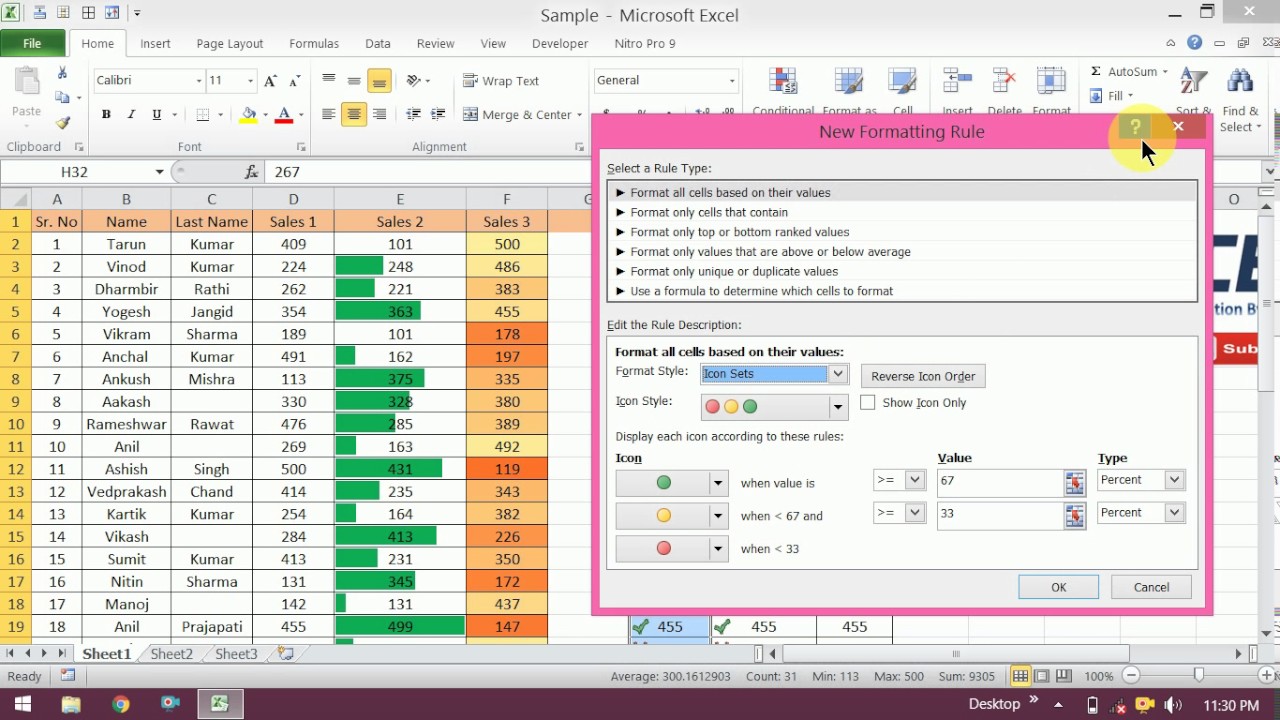
From Home tab, click on Conditional Formatting & select New Rule
Or press ALT + O + D shortcut
This will open New Formatting Rule Manager
Select “Use a formula to determine which cells to format”
Enter the formula as =AND(OR($A4>=40,$A4<=50),FIND('5',$B4,1)=1)
Click on Format & select the color & click on OK twice.
Conditional Formatting In Microsoft Word New Nevada Title
In this way, we can highlight the rows which are matching the criteria.
Wes Preston (@idubbs) originally published this article on his blog, and we thought it was worth sharing here. Enjoy!
*Disclaimer* – This post based on Preview version of PowerApps. I’ll make every effort to update with any changes and verify when PowerApps is released.
So far, I’m LOVING the potential that PowerApps brings to the table for power users. Coming from the SharePoint side of the world, lots of folks are going to be interested in how conditional formatting works within PowerApps. Here is one example – I’m sure there will be more.
The formatting is implemented using a formula on the Color property of the control.
If the value being checked is ‘High’, then make the Color red. If not, then make the color Black.
I have a Display form.
The ‘Priority’ field that I’m checking the value of is on card: DataCard6
With this information, I can change any of the Color properties for other controls to:
If(DataCard6.Default.Value=”High”, Red, Black)
Note: for the card of the Priority field, I can alternatively use the following:
If(Parent.Default.Value=”High”, Red, Black)
On the Browse screen, we access the data a little differently, so it looks like this:
If(Priority.Value=”High”, Red, Black)
Regarding multiple values, like typical KPI (key performance indicator) examples – Red, Yellow, Green for example – you need to nest the formula logic like this:
If(ReqType.Value=”Type1″, Red, If(ReqType.Value=”Type2″, Yellow, If(ReqType.Value=”Type3″, Green, Black)))
(Yellow, by the way, looks terrible on a white background. )
Think of it as an ElseIf kind of construct by filling in the ElseResult (as mentioned in the IF reference below).
It’s a bit of a learning curve for PowerApps with all the new terms, different ways of referencing data, etc. but Microsoft has done a great job with initial documentation, examples, etc. Some of the links below will get you started poking around.
Conditional Formatting In Word Document
References:
Getting started with formulas (PowerApps Reference)
If function in PowerApps (PowerApps Reference)
Understand data forms (PowerApps Reference)